
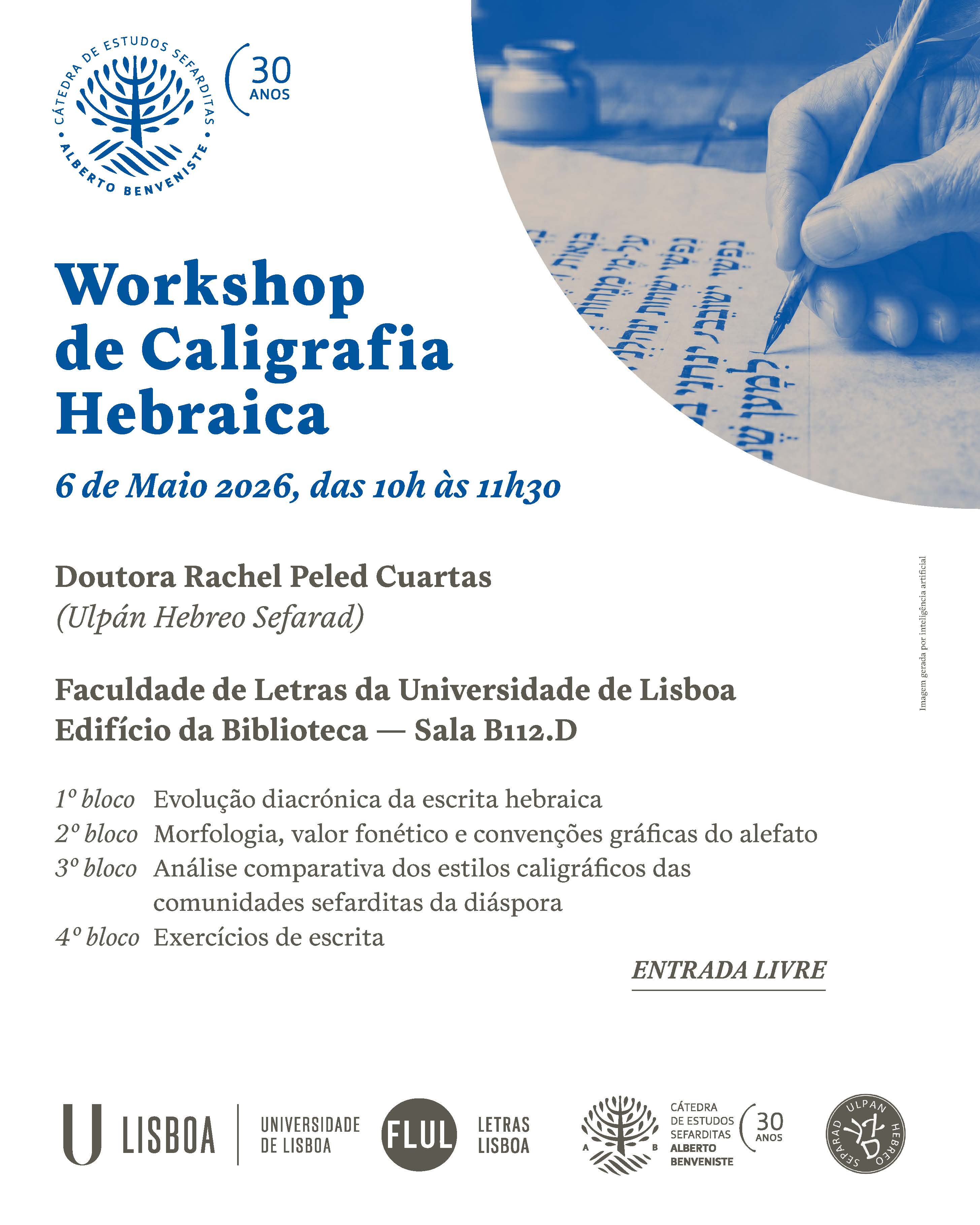
CESAB invites you to explore one of the oldest and richest scribal traditions of humankind. In this workshop, Rachel Peled Cuartas will approach the study of Hebrew calligraphy from a historical, palaeographic, and comparative perspective, without renouncing the pleasure of discovering —and tracing with our own hands— the forms of an ancient writing system.
The session is structured into four thematic blocks. The first addresses the diachronic evolution of Hebrew script from its origins in Paleo-Hebrew, taking as a foundational epigraphic reference the Gezer Tablet —one of the oldest inscriptions preserved in the Hebrew language, nearly three millennia old— up to its contemporary form.
The second block offers a systematic presentation of the aleph-bet, addressing the morphology, phonetic value, and graphic conventions of each grapheme.
The third block constitutes one of the most revealing aspects of the workshop: a comparative analysis of the calligraphic styles that crystallised in the different communities of the diaspora, examining their distinctive formal features and the processes of influence and exchange with the writing systems of surrounding cultures.
Finally, the fourth block is eminently practical: writing instruments will be taken up and participants will apply what has been learned, experiencing first-hand the rhythm and discipline required by Hebrew calligraphic practice.
The workshop is aimed both at scholars of Hebrew language and culture and at anyone interested in palaeography, the history of writing, and book arts. No prior knowledge of Hebrew is required (although it is helpful): only curiosity is needed to approach a script that has accompanied a people across millennia and diverse geographies.
Rachel Peled Cuartas holds a PhD in Religious Studies from the Complutense University of Madrid (Cum Laude). She is a researcher and translator of medieval Hispano-Hebrew literature.
She completed her postdoctoral research at the Department of Ibero-American Studies of the Hebrew University of Jerusalem, specialising in the representation of women in Hebrew and Romance-language literature (13th–15th centuries).
She has been co-director and lecturer in Sephardic Studies, Medieval Mediterranean Languages, and Biblical Hebrew programmes at the Instituto de Investigación de Estudios Medievales y del Siglo de Oro Miguel de Cervantes (IEMSO), University of Alcalá.
Founder and director of Ulpán Hebreo Sefarad, she has also collaborated with the Free University of Berlin on an international project concerning Hebrew versions of Calila e Dimna.
Among her publications stands out the translation Poemas seletos de Todros Abulafia (Ediciones Hiperión, 2019), as well as numerous articles on intercultural dialogue between Jewish, Christian, and Muslim traditions in medieval Iberia.
May 6, 2026, 10am
Room B112.D (Faculty of Arts and Humanities, University of Lisbon, Library building)
Free admission